 |
Copyright Information ©
Sci - Fi Visions ©, NERD BIZ©, and
SCI FI VISIONS © are registered trademarks of nerdbiz© and their
respective owners. All material contained in nerdbiz.biz &
donaldspix.com is the property of Donald Murphy Spix©. If you wish to use any
images, information, etc. please send a request to nerdbiz.biz
donaldspix at gmail.com
Dungeons & Dragon, Star Trek, Star Wars & other Sci Fi/ / Fantasy objects appearing on
this website are copyrights belonging to said companies Donald Murphy Spix
acknowledges that said companies and said graphics are based off of said
companies. All images on this website are registered. NERD BIZ DOT BIZ.© Is
copy written and all registered 3 Dimensional graphics, even "REQUESTED"
materials done By Donald Murphy Spix should not be used with out written
consent!
© MCMXCVIII, ©
MMXXIII
|
|
 |









On UMC ships, it
was generally located near the top and front of a vessel. From here, the
commanding officers supervised all ship's operations, ranging from vessel
course control to tactical systems.
On UMC vessels, the bridge was usually located on Deck 1, on top of the
vessel's primary hull. How ever the Hornet class bridge is located front
forward of the nose section.
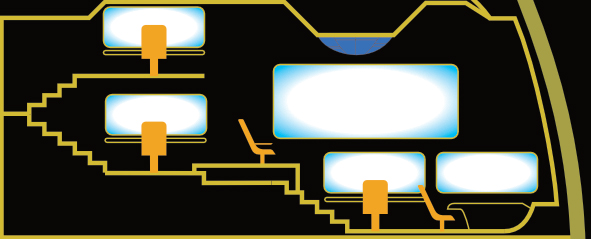
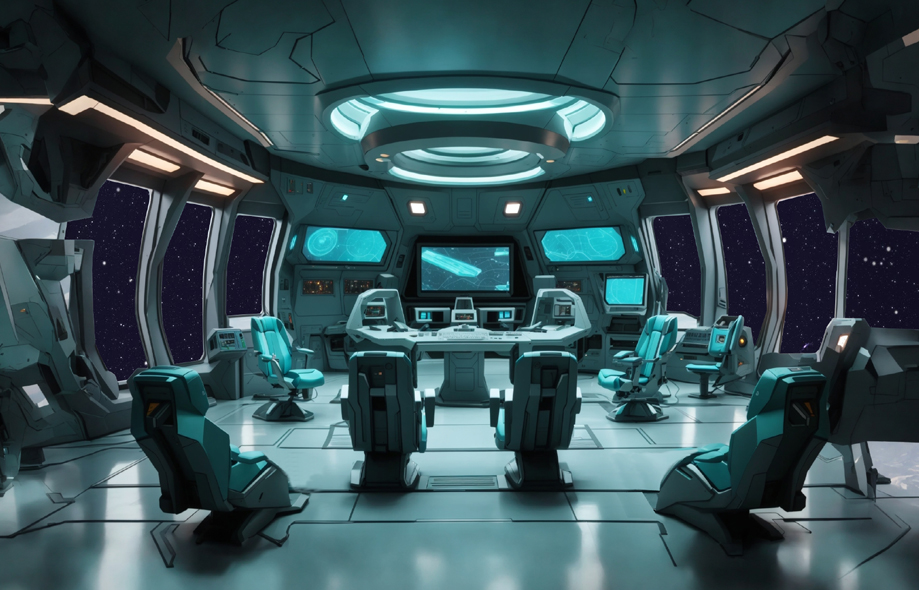
The bridge was
the nerve center of every starship, and it was manned by the top officers of
each department except for engineering and medical. There was typically an
engineering station that the chief engineer could use when on the bridge, as
well as science stations that the science officer or chief medical officer
could use.
The commanding officer could supervise all the ship's operations while
seated in the command chair, typically located in the center of the room,
while having visual access to all major personnel stations and viewscreens,
facilitating the decision-making process. By the mid-24th century, the
standard was that a first officer was assigned to assist a ship's captain in
this process.
The forward bulkhead of the bridge was typically dominated by the main
viewscreen. Directly in front of this was usually the helm console, from
where navigation and vessel course control were carried out.
Many of the support stations that were present on 23rd century bridges were
combined into one post by the 24th century, mainly that of the operations
officer. Some bridges featured an operations console alongside the helm
station, from where the officer on duty had access to internal systems
control, communications, sensors, resource scheduling, and hardware and
system usage.
Each bridge typically featured several supportive consoles for engineering,
gravity control, damage control, environmental engineering, sciences, and
library computer, most of which did not necessarily need to be manned under
normal circumstances. Internal security along with weapons control could be
found at the security station.